AI workshops, Singapore

AI workshops for business teams
in Singapore.

Geargina Tan is a Singapore-based AI workshop facilitator who gets business teams using Claude and ChatGPT for real work. She is co-founder and COO of WTFox.ai and writes as Coach Gina. Sessions run 2 hrs, 3 hrs or a full day, in person in Singapore or online.

Last updated 9 September 2026

Who these workshops are for

01

Teams new to AI

This is the normal starting point, not the exception. At the BNF Group strategy retreat in Mar 2026, a room of 40+ senior managers had almost no AI use between them. Nobody gets asked to write code, and every term gets defined the first time it shows up.

Most rooms
02

Leadership groups planning adoption

You need one shared picture before you can decide anything. What these tools do, where they break, who owns the output when an agent writes it. Senior people are usually the sceptical ones, and that scepticism is worth keeping rather than talking out of them.

Before the rollout
03

Women's professional networks and communities

Shorter, warmer, still hands-on. The Podium Insight Hour on 18 Jun 2026 ran 2 hrs for a small group of women professionals, working on their own tasks rather than a demo dataset.

Community format
04

Partner training providers

Academies, communities and training businesses that want practical AI in the catalogue without building it. You own the audience and registration, the curriculum comes ready to teach. Details in the partner section below.

Partner model

How a session actually runs

This is the real run sheet from the 3 hr format, the one that ran two nights in Aug 2026. Times are elapsed from the hard start. Laptops are open from the beginning and the room types along with the demos, then there are three protected blocks where everyone builds on their own work.

Doors and login triage

Auth is the number one time thief in a hands-on room. Doors open early purely so anyone staring at a red screen gets fixed before the clock starts.

Welcome and the level check

90 seconds on who is teaching, then hands up. 3 questions, and I watch the drop between the second and the third, then say it out loud. The gap between paying for a tool and getting value back from it is the whole reason the room is here.

Foundations, fast

What AI is, how it learned, a 60-second history, and the car wash test where a thinking model still walks through the car wash. The point I want in their heads before anything else: AI follows patterns, not logic, and your context is what turns those patterns into reasoning.

Chat, properly

Which model to reach for, the effort dial, and how to brief one like a new hire on their first day. Then the same question asked twice live, cold first and briefed second. Nobody argues with the difference once they have watched it. Hallucination gets said plainly here, not buried.

Connectors and the safety question

Chat gives the assistant a brain, connectors give it hands. A 2 minute inbox triage demo, then the answer to the question every room asks. Your login, deliberately narrow access, Drive read-only and Gmail read and draft. It reads and it drafts. It does not send, because I am the one who presses send.

Projects, then 30 min of building

Chat starts cold, a Project answers warm. I build one live on a real task, including the moment it refuses to invent experience that is not in the file. Then the room builds their own for 30 min. This is the biggest block on the sheet and it never gets cut.

Break

10 min. The openers slide stays up so anyone who wants to keep typing can.

Skills, then 15 min of building

Teach it once and it sticks. We scroll a real skill file, no code anywhere in it, then I change one line live and the behaviour changes with it. Then everyone writes their first one, usually by asking Claude to draft it, which is the fastest route for a beginner room.

Agentic work, then 15 min of delegating

Chat answers, an agent finishes. One demo of a job running end to end, narrated while it ticks, then everyone hands over a real task of their own. The habit I want installed is files plus outcome, not steps, and then reviewing the result like it came from a new hire.

Show and tell, and the 30-day path

2 or 3 volunteers, one minute each, picked because I saw them make something interesting during a build block. Then what to do in week one, week two, week three and at day 30, and the follow-up email with the prompts and the checklist.

What I ask people to bring

Sent to every participant 3 days before the session, in these words.

  • An account on the tool we are using, signed up and logged in before you arrive.
  • Your laptop and your charger.
  • One real piece of work. A report you write monthly, a deck you are building, a process doc. If you are between roles, bring your resume and one job ad you are eyeing instead.
  • Know your Google password. Connecting your tools happens live and the login is yours to do.

Some formats need a paid plan for the agentic block. That gets confirmed on the scoping call, never sprung on the room.

Three formats, side by side

Same ladder every time. The format decides how far up we get in one sitting.

Format Length Best for What everyone builds Laptops Price guidance
Short session 2 hrs A department or a community group that needs one shared starting point Chat and context only. A briefed prompt on a real task, and a Project holding their own documents. Skills and agentic work need longer. Yes, one each Scoped per team
Core workshop 3 hrs A team that wants to leave using AI on Monday, not thinking about it The full ladder. A Project on their own work, their tools connected, a first custom skill, and one task handed over end to end. This is the format that ran in Aug 2026. Yes, one each Scoped per team
Full day 9:30 to 16:30 A small private cohort going deeper, with time to get properly stuck and unstuck The same ladder with longer build blocks, so groups get further and present what they made. Last run on 20 Jun 2026 for a private cohort of 6 to 7. Yes, one each, plus power at seats Scoped per team

Cohort cap is 30. Above that the floor helpers cannot reach everyone during a build block, which is where the workshop is actually won.

What we measure

Same short anonymous survey before the session and again after it, so you get something to look at other than the room nodding.

The instrument

Three self-rated confidence questions, each on a 1 to 5 scale, asked identically before and after.

  • How confident are you setting up a Project?
  • How confident are you writing a custom skill?
  • How confident are you delegating a piece of end-to-end work?

The post survey adds a pacing question and a free-text box. Both surveys are anonymous, which is why the free text is worth reading.

From the Aug 2026 Claude Masterclass, 91% of survey respondents rated the pacing just right, which was 10 of 11. Self-rated confidence in setting up a Claude Project rose 48%. The caveat travels with the number: 19 people answered before and 11 answered after, and they are not the same 11, so this is post-session feedback rather than a study. Anyone who tells you a 3 hr workshop produced a measured productivity gain is selling you something.

What went wrong, and what changed

Logins. In earlier sessions the first 15 min went to people who could not get into their account, and that time comes straight out of the block you least want to lose. What changed: doors now open 15 min before the hard start purely for login triage, the pre-work note asks everyone to log in before they arrive, and the Projects block does not begin with anyone still locked out.

Still open, and worth saying out loud. Two people in Aug asked for one diagram placing Projects, Skills, Artifacts, Connectors and Cowork in a single picture, because the vocabulary arrived one term at a time and never as one image. Fair hit. That slide is top of the fix list and it is not built yet.

Proof

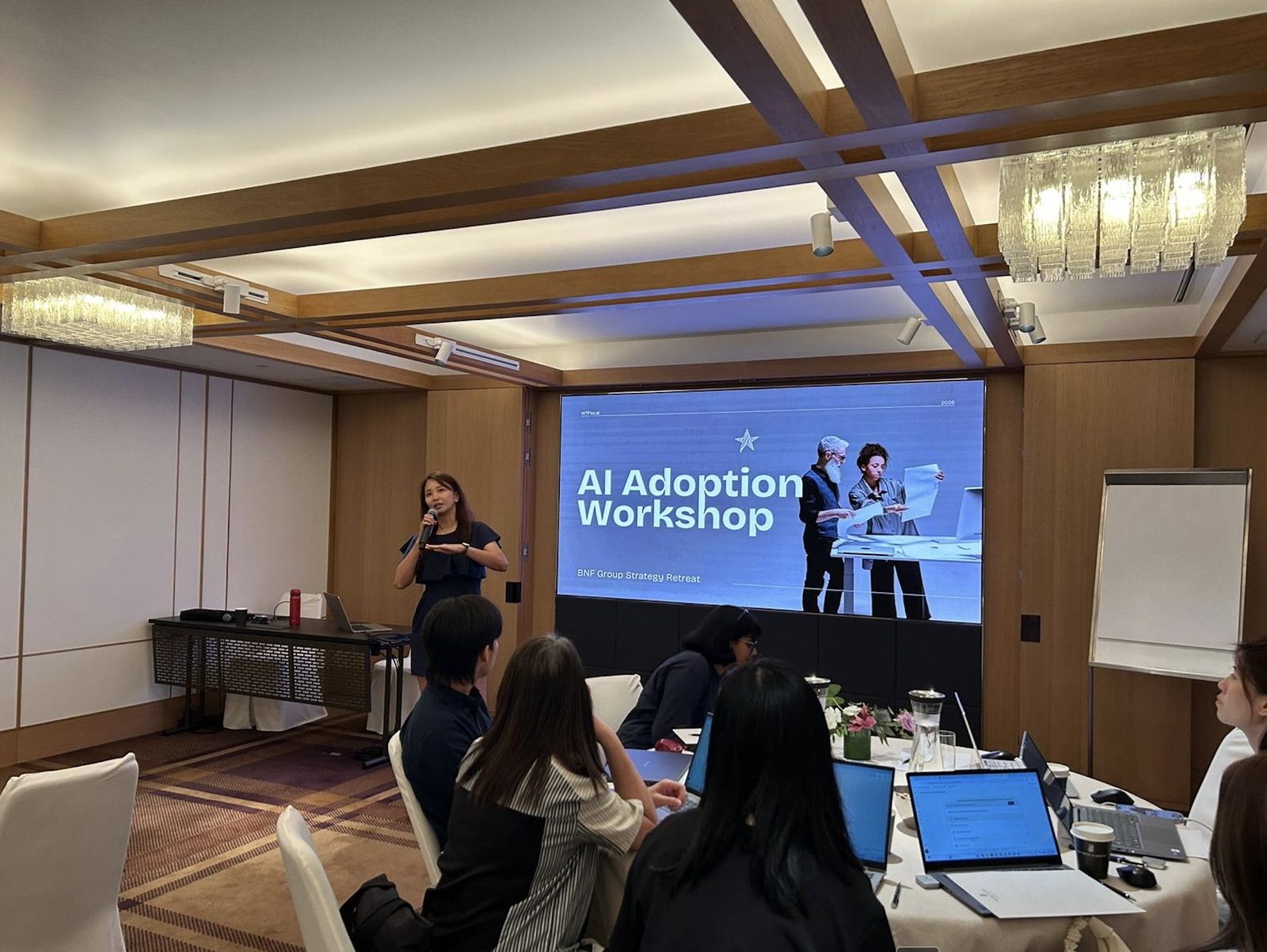
Photograph of Geargina Tan (Coach Gina), AI workshop facilitator in Singapore and COO of WTFox.ai, presenting her 3 hr AI adoption workshop to 40+ senior managers at the BNF Group strategy retreat, Ritz-Carlton Singapore, March 2026. Real photo, attendees seen from behind. Corporate AI training in Singapore.
BNF Group strategy retreat, 30 Mar 2026
Photograph from the Claude Masterclass 101 run by Geargina Tan (Coach Gina) with Cogentic AI Partners at SQ Collective, Singapore, August 2026. Real photo of attendees working on laptops, shot from behind the room. Hands-on AI workshop for business teams in Singapore.
Claude Masterclass 101 with Cogentic AI Partners, Aug 2026
Photograph of Geargina Tan (Coach Gina), AI workshop facilitator in Singapore, at the screen opening the Podium Insight Hour session for women professionals, 18 June 2026. Real photo. AI training for teams and communities in Singapore.
Podium Insight Hour, 18 Jun 2026
"Geargina has very good 'trainer' skills. She knows the stuff well and is able to articulate the approach very clearly with simple illustrations and drawing comparisons to things we easily understand."
A
Anonymous responsePost-session survey · Claude Masterclass, Aug 2026
"Yesterday's session was terrific! Geargina was very knowledgeable, and my mind was focused on how the learning could be used in everyday life, not just work."
V
VijuMasterclass attendee

For training providers and communities

The Aug 2026 masterclass ran on a partner model, and it worked well enough that I am open to the same setup again. Cogentic AI Partners owned the marketing, the registration and the relationship with their community. I built the curriculum and taught it. You keep control of your audience and your pricing, the session arrives ready to run, and we agree a revenue share per programme rather than a fixed fee. It suits academies, professional communities and training businesses that want practical AI in the catalogue without building it from scratch.

Propose a partnership

Questions before you book

How do I scope an AI workshop for my team?

Start with who is in the room. Group size, seniority, the tools they already pay for, how much AI they have actually touched, and the industry context that makes a generic example fall flat. Then the outcome. What should these people be doing differently next Monday. Send that on the contact form and you get a format and a shape back.

Do participants need any technical background?

None at all. Most rooms are people who have never opened an AI tool, and every technical term gets a plain English definition and an analogy the first time it appears. Everyone needs a laptop, an account logged in before the start, and one real piece of their own work. A report you write every month is the perfect thing to bring.

Can the workshop run online?

Yes. The LHH session in July 2026 ran online for around 25 senior professionals in career transition, and other online rooms have had people joining from Indonesia and the Philippines. Online suits a talk or a 2 hr session well. For a full day, in person wins, because the build blocks depend on being able to look over shoulders.

How much notice do you need?

A few weeks, and more when the session is built on your own documents. The prep is what makes it worth doing. A scoping call, reading what your team actually works on, and rewriting the exercises onto your material. A short-notice request is still worth sending, because a smaller room or a standard format can usually be made to fit.

Read the long versions

Two write-ups of real sessions: the Claude Masterclass 101 and the BNF Group workshop. If your team is going in on Claude specifically, the Claude workshop page covers that ladder in more detail. For conference talks and panels rather than workshops, see speaking. And on the blog: what an AI workshop for a Singapore team actually looks like and why "just use ChatGPT" is bad advice.

Let's get your team using it

Tell me who is in the room.

Group size, how long you can give me, and what you want them doing differently next Monday. You get a straight answer on whether a workshop is the right thing, and I reply within 2 business days.